May 03
3:15 PM
Twitter Emerges as a Viable Direct Marketing Channel
A few weeks ago I spoke on a panel at Leadership Music Digital Summit in Nashville and was asked, “So you’re saying that email marketing is still more important than, say, Twitter or Facebook?” I responded, “Yes. Quantifiably.” I went on to say that in the campaigns Topspin has run so far we’re seeing Facebook represents 2-4% of first-week sales and Twitter 1-2%.

Then, just two weeks later, Jimmy Eat World made a liar out of me. Through killer Twitter integration into their tour (via the band’s support for the medium and spearheading by one of our favorite young geniuses, Lee “Chauvin” Martin at Silva Artist Management) Jimmy Eat World managed to accumulate 200,000 Twitter followers in just over 30 days (as of this writing they’re over 350,000 followers). Considering I started bringing bands online in the early 90s and remember it taking 5+ years to collect more than 100K email addresses, this is a pretty impressive feat of modern technology and critical mass around social tools IMHO. The tour culminated with a release of the music from their hometown show in HD audio. The band posted news of the release to their Twitter stream, and offered fans a chance to enjoy an encore performance live via Ustream. All of this was connected to a live Twitter feed featuring fans comments about the album and performance (via the hash tag #claritylive) on the front page of their site. The fans re-Tweet’d the news and boom, copies of the album were sold. Lee explains it well, “It’s as if you were in a record store looking at the new Jimmy Eat World release and 1000 people standing next to you told you how good it was.”
In the first day of release, Twitter lead the traffic drivers to the Jimmy Eat World site, with more than 22% of all traffic coming straight outta Twitterland. Twitter was third as a driver of revenue, though, driving just over 20% of all sales. Still, with the large number of people reached, and email a smaller percentage of total sales in this campaign than we see on average, it’s very reasonable to conclude that Twitter was a meaningful driver of incremental revenue in this case, and there’s no question they proved you can do much better with Twitter than I led the crowd in Nashville to believe just a couple weeks previous.
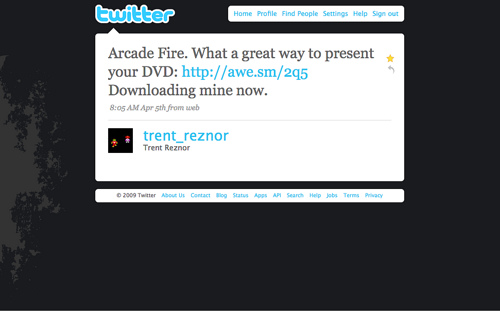
Trent Reznor drove a separate but similarly interesting Twitter event when he re-Tweeted one of my Tweets about the Arcade Fire DVD release, Miroir Noir. Arcade Fire started selling a feature-length film from their Website (via Topspin) back in December. It was a successful release, but sales had died down as of late. A few weeks back, the deluxe DVD I ordered for myself came in the mail to my house, and I simply Tweet’d that fact. Trent saw the Tweet, checked it out, liked it, and Tweet’d that he thought it was a great way to release a DVD, and that he bought one. Trent had about 250,000 followers at the time (as of today he’s well over 400,000), many of them visited, and some of them took the liberty to re-Tweet themselves. Check out the report below from TweetReach to see the spread of the re-Tweet activity over the first day or so (reprinted with permission from Hayes Davis at TweetReach — thanks, yo).
What’s interesting is this single event added meaningful incremental sales to the project, many months after the original release. The behavior mirrored that of a “Slashdot Effect”, large volume and low conversion (conversion to sale was less than half a percent, compared with 11% for the email campaign), but an impressive and needle-moving revenue number simply from one person giving a less-than-140-character endorsement.
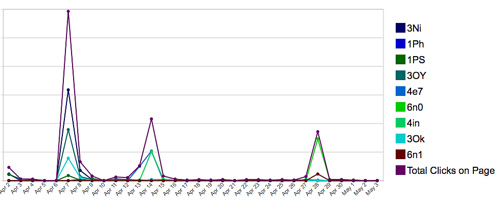
Also interesting are the tools we are able to use to track this sort of thing. Note Trent re-Tweet’d the shortened URL I Tweet’d originally, http://awe.sm/2q5. This was made with a URL shortening service Awe.sm (full disclosure: this is my good friend Jonathan Strauss’ company and I’m involved on an advisory basis) and as a result I can easily track the click-throughs on the URL. Between Twitter Search, TweetReach, Awe.sm (or other great services like bit.ly), Google Analytics, and the Topspin sales data one can pull together (and cross-check) some pretty interesting data on reach and conversion down the path to purchase. One interesting finding: 25% of the clicks on the URL came from OUTSIDE the Web, that is, mobile and AIR/desktop clients.
What to conclude from all this? That Twitter is the marketing machinery of the future? Naw. This isn’t about “the next big thing”. It’s about how little we know about how marketing will work and how transactions (not just purchases, but any kind of value exchange) will be earned (and I do mean earned) in the future. Success is highly variable. Execution matters (as James said). Unexpected events can make an impact. People are powerful marketers. But not only are the drivers for traffic evolving, the tools we use to measure the attention economy are going through a really interesting growth phase. It’s hard not to be excited by seeing some of these tools work in ways that are more than just novel, they’re shuffling meaningful amounts of attention around and making real money for artists. Exciting times indeed.
